Cascading Symbol Interactions and Their Influence on Win Multipliers Across Gonzo's Quest, Sweet Bonanza, and Gates of Olympus
Kirjoittanut Otto Peters · 20.8.2026
Cascading Symbol Interactions and Their Influence on Win Multipliers Across Gonzo's Quest, Sweet Bonanza, and Gates of Olympus
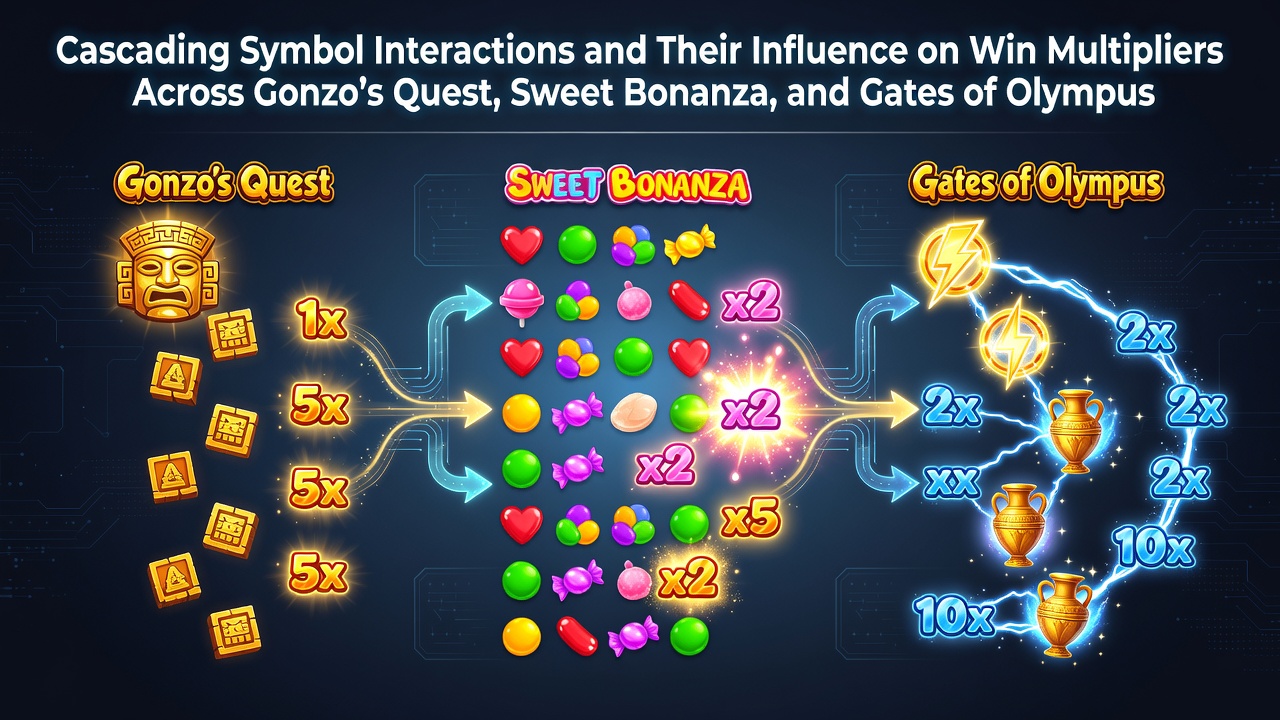
Slot mechanics that rely on cascading symbols create chained sequences where winning combinations disappear and new symbols fall into place, often building win multipliers along the way. In Gonzo's Quest, Sweet Bonanza, and Gates of Olympus these interactions follow distinct rules that directly scale payout potential through progressive multiplier systems.
How Avalanche Mechanics Operate in Gonzo's Quest
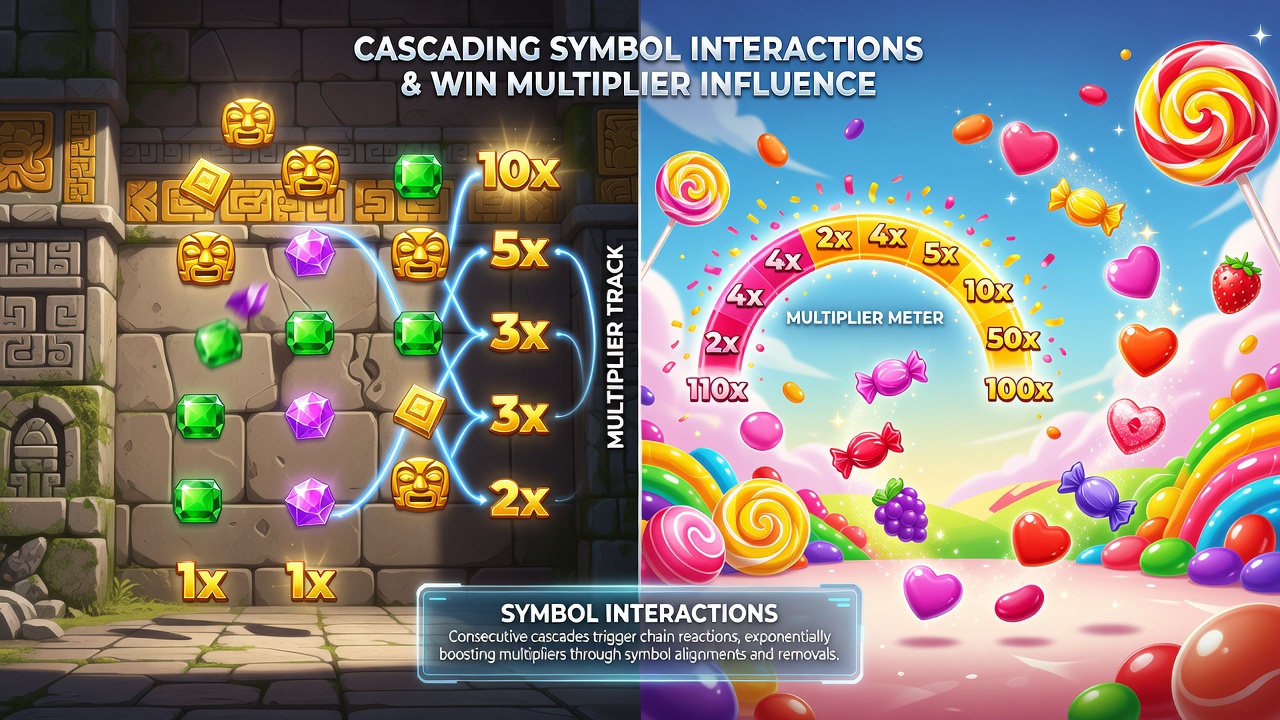
NetEnt's Gonzo's Quest introduced avalanche reels in 2010, replacing traditional spins with falling stone symbols that remove winning clusters and allow fresh symbols to drop from above. Each successive avalanche within a single spin increases a multiplier that starts at 1x, moves to 2x after the first cascade, reaches 3x on the next, and climbs to 5x thereafter according to the game's published rules. Observers note that this structure rewards extended chain reactions because the highest multipliers activate only after multiple removals occur in sequence, while base game wins remain modest until the multiplier climbs.
Tumble Feature and Bomb Multipliers in Sweet Bonanza
Pragmatic Play's Sweet Bonanza uses a tumble system on an 8x6 grid where symbols pay anywhere rather than on fixed paylines. Winning clusters vanish and new symbols fall, continuing until no further matches form. Scattered bombs then trigger a separate multiplier phase that applies values ranging from 2x to 100x across all tumbles in that round. Data from game documentation shows these multipliers combine with the number of tumbles to produce larger aggregate payouts, and the feature activates randomly during both base play and the free spins round where multipliers receive an additional boost.
Multiplier Activation Patterns in Gates of Olympus
Pragmatic Play's Gates of Olympus employs cascading mechanics similar to Sweet Bonanza yet layers Zeus symbols that assign random multipliers between 2x and 500x during each tumble sequence. When Zeus appears he multiplies the current win before symbols continue to fall, and multiple Zeus symbols in one cascade stack their values. Research indicates that the frequency of these multipliers increases during the free spins mode where every tumble guarantees at least one Zeus appearance, altering the distribution of win sizes compared with base game play.
Comparative Influence on Win Multipliers
Across the three titles the interaction between cascades and multipliers follows different timing and scaling rules. Gonzo's Quest ties multiplier growth strictly to avalanche count, creating predictable escalation once chains begin. Sweet Bonanza separates the multiplier trigger into bomb symbols that apply after tumbles conclude, allowing large multipliers to affect the cumulative result of an entire sequence. Gates of Olympus integrates multipliers directly into each cascade through Zeus symbols, producing variable spikes rather than steady progression. Those who've examined payout tables observe that these design choices shift the point at which multipliers exert maximum influence on total returns.
Industry reports compiled by the European Gaming and Betting Association highlight how cascade-based multiplier systems appear across multiple jurisdictions and influence session length patterns. In August 2026 regulatory filings from the Malta Gaming Authority noted continued player engagement with titles featuring progressive multipliers, though aggregate return-to-player figures stayed within published ranges for each game. Academic studies on random number generator behavior confirm that the visual feedback of cascading symbols does not alter underlying probability but does extend the duration of individual spins through repeated evaluations.
Multiplier Stacking and Sequence Length
Sequence length determines multiplier impact in each title because longer cascades provide more opportunities for multiplier application. In Gonzo's Quest the 5x cap activates after three avalanches, so additional chains beyond that point receive the maximum without further increase. Sweet Bonanza allows bomb multipliers to combine across all tumbles in a round, meaning a single high-value bomb can multiply an entire series of smaller wins collected earlier. Gates of Olympus permits stacking when several Zeus symbols land during one cascade, producing multipliers that exceed the individual values shown on any single symbol. Figures released by the Canadian Gaming Association indicate that games with stacking multipliers record higher variance in win distribution compared with those using incremental steps.
Conclusion
Cascading symbol systems in Gonzo's Quest, Sweet Bonanza, and Gates of Olympus each link chain reactions to multiplier growth through distinct mechanical pathways. Gonzo's Quest escalates multipliers by avalanche count, Sweet Bonanza applies bomb values after tumble sequences end, and Gates of Olympus inserts random Zeus multipliers during active cascades. These interactions produce different payout rhythms while operating under the same foundational principle that extended symbol removals increase the scope for multiplier application. Regulatory data from multiple regions continues to track these mechanics as part of broader slot performance monitoring.